
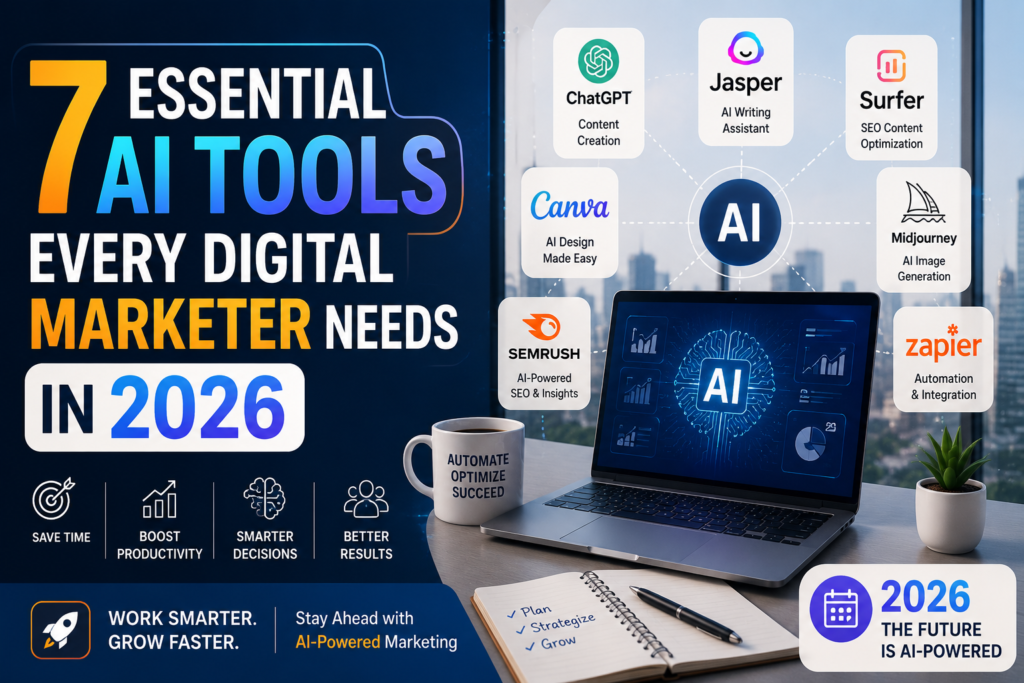
7 Essential AI Tools Every Digital Marketer Needs in 2026
AI is changing the way digital marketers research, create, optimize, analyze, and manage campaigns. In 2026, marketers don’t necessarily need dozens of complicated tools. The right AI tools can help save time, improve productivity, create better content, and make data-driven marketing decisions.
Whether you’re a digital marketing freelancer, business owner, social media manager, SEO professional, content creator, or agency marketer, using AI effectively can help you handle repetitive tasks faster and spend more time on strategy and creativity.
But AI should not replace human thinking. The best results come when marketers use AI as a productivity and decision-support tool while keeping human creativity, judgment, fact-checking, and brand understanding at the center.
In this guide, we’ll explore 7 essential AI tools for digital marketers in 2026, what each tool is useful for, and how you can include them in your everyday marketing workflow.
What Is AI in Digital Marketing?
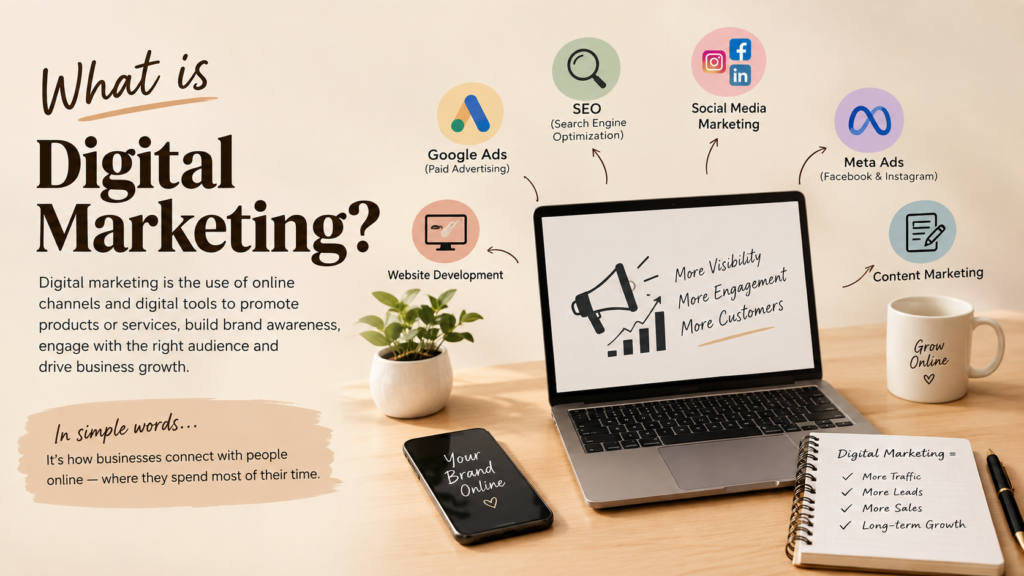
AI in digital marketing refers to using artificial intelligence to assist with tasks such as content creation, keyword research, campaign planning, image generation, data analysis, customer research, automation, and marketing optimization.
Instead of manually completing every repetitive task, marketers can use AI to speed up the process.
For example, AI can help a marketer:
- Generate content ideas
- Create blog outlines
- Research audiences
- Analyze marketing data
- Create social media designs
- Improve SEO content
- Organize campaigns
- Automate repetitive workflows
- Generate advertising ideas
- Identify trends and patterns
However, AI-generated information should always be reviewed before publishing, especially when dealing with facts, statistics, business claims, or customer-facing content.
Why Do Digital Marketers Need AI Tools in 2026?
Digital marketing has become more competitive and more complex. Marketers often have to manage SEO, content, social media, advertising, analytics, design, emails, and multiple client campaigns at the same time.
AI can help reduce the amount of time spent on repetitive work.
Some major benefits include:
1. Saves Time
AI can help marketers complete research, brainstorming, drafting, and repetitive tasks much faster.
2. Improves Productivity
Instead of starting everything from scratch, marketers can use AI to create first drafts and ideas.
3. Supports Content Creation
AI can help generate content outlines, captions, headlines, email ideas, and campaign concepts.
4. Helps Analyze Data
AI-powered analytics features can help identify trends and unusual changes in marketing performance.
5. Makes Design Easier
AI design tools allow marketers to create professional-looking visuals without advanced graphic-design skills.
6. Supports Better Decision-Making
AI can organize information and identify patterns, but marketers still need to make the final strategic decisions.
How We Selected These AI Tools
For this list, we focused on tools that can be useful in practical digital marketing activities such as:
- Content creation
- SEO
- Social media marketing
- Graphic design
- Analytics
- Campaign planning
- Productivity
- Marketing strategy
The goal isn’t to find the tool with the most AI features. Instead, the focus is on how useful the tool can be in a real digital marketing workflow.
1. ChatGPT – Content & Marketing Strategy
ChatGPT can be useful for marketers who regularly work with content, research, brainstorming, and marketing strategy.
Instead of staring at a blank page, marketers can use it to develop ideas, create content structures, generate campaign concepts, and organize information.
Best For:
- Content ideas
- Blog outlines
- Social media captions
- Marketing copy
- Email ideas
- Audience research
- Content calendars
- Campaign brainstorming
How Digital Marketers Can Use It
A marketer can use ChatGPT to create a first draft of a blog structure, generate multiple headline ideas, brainstorm social media topics, or create variations of advertising copy.
However, don’t simply copy and publish raw AI-generated content.
Use AI for research, brainstorming, structure, and first drafts, then add your own expertise, examples, brand voice, and fact-checking.
Pro Tip
Give AI detailed context instead of using a one-line prompt.
For example, instead of:
“Write an Instagram caption.”
Try:
“Create a professional Instagram caption for a digital marketing freelancer targeting small businesses in Mumbai. Keep it conversational, include a clear CTA, and focus on generating leads.”
The more useful context you provide, the more relevant the output can become.
2. Claude – Content Research & Writing Assistance
Claude is another conversational AI tool that can be useful for marketers working with long-form content, brainstorming, research organization, and writing.
It can help marketers work through large amounts of information and develop structured content.
Best For:
- Long-form content
- Content planning
- Research organization
- Copywriting
- Brainstorming
- Document analysis
- Content editing
How Digital Marketers Can Use It
A marketer can use Claude to develop a detailed blog outline, organize research notes, improve an existing draft, or generate different versions of marketing copy.
It can also be useful when working on lengthy documents or complex marketing ideas.
Pro Tip
Use AI as your first assistant, not your final editor.
Always review the output for accuracy, originality, tone, and relevance before publishing.
3. Rank Math / Yoast SEO – On-Page SEO Optimization
SEO plugins such as Rank Math and Yoast SEO can help marketers optimize website content directly inside WordPress.
These tools provide recommendations that can help marketers improve elements such as keywords, titles, meta descriptions, readability, internal linking, and structured data.
Best For:
- On-page SEO
- WordPress optimization
- SEO content checks
- Meta titles
- Meta descriptions
- Schema
- Content optimization
Why It Matters in 2026
Search is evolving beyond traditional blue-link results. Search engines and AI-powered systems increasingly need to understand the meaning, structure, context, and credibility of content.
Properly structured content can make it easier for search engines to understand a webpage.
Pro Tip
Don’t try to achieve a perfect SEO score just for the sake of getting a green indicator.
A page should first be useful to humans. SEO recommendations should support the content rather than make it unnatural.
4. Canva AI – Visual & Social Media Design
Visual content is an essential part of digital marketing, particularly for social media, advertising, websites, presentations, and blog content.
Canva’s AI-powered features can help marketers create and modify designs faster without requiring advanced graphic-design knowledge.
Best For:
- Instagram posts
- Reels
- Social media graphics
- Blog banners
- Advertisements
- Presentations
- Brand visuals
- Content resizing
How Digital Marketers Can Use It
A marketer can create a social media post, generate design variations, remove backgrounds, adapt designs for different formats, and create visual assets for campaigns.
This can be especially helpful for freelancers and small businesses that don’t have a dedicated designer.
Pro Tip
AI can help create the design, but your brand identity should remain consistent.
Keep your fonts, logo, messaging, visual style, and brand guidelines consistent across platforms.
5. Google Analytics 4 – AI-Powered Data & Insights
Creating campaigns is only one part of digital marketing. Understanding what happens after people interact with those campaigns is equally important.
Google Analytics 4 helps marketers understand website and app user behavior and measure important events and conversions.
Its automated insights and machine-learning capabilities can help marketers identify patterns and changes in performance.
Best For:
- Website analytics
- Traffic analysis
- Conversion tracking
- User behavior
- Campaign measurement
- Performance analysis
How Digital Marketers Can Use It
A marketer can use GA4 to understand:
- Where website visitors come from
- Which pages receive traffic
- Which campaigns generate results
- How users interact with a website
- Where users leave the conversion journey
- Which marketing channels contribute to conversions
Pro Tip
Don’t focus only on traffic.
A website receiving 10,000 visitors isn’t necessarily successful if those visitors don’t take meaningful actions.
Track business outcomes, such as leads, purchases, sign-ups, calls, or other important conversions.
6. Notion AI – Marketing Planning & Productivity
Managing digital marketing involves much more than creating content.
Marketers also need to manage:
- Content calendars
- Client information
- Campaign ideas
- Meeting notes
- Tasks
- Research
- Marketing strategies
- Project deadlines
Notion AI can assist with organizing and working with this information.
Best For:
- Content calendars
- Campaign planning
- Notes
- Research
- Task management
- Content organization
- Team collaboration
How Digital Marketers Can Use It
You can create a content calendar, organize campaign information, summarize meeting notes, brainstorm content ideas, and keep marketing resources in one place.
Pro Tip
Create a repeatable marketing workspace.
For example:
Client → Strategy → Content Calendar → SEO → Social Media → Ads → Analytics → Reports
This makes it easier to manage multiple projects without constantly searching for information.
7. Trello – AI-Assisted Campaign & Task Management
Digital marketers often work on multiple campaigns simultaneously. Without proper organization, tasks can quickly become difficult to manage.
Trello can help marketers organize campaigns using boards, lists, cards, deadlines, and workflow stages.
Best For:
- Campaign planning
- Task management
- Content calendars
- Team collaboration
- Client projects
- Marketing workflows
Example Marketing Workflow
You could create a board like:
Content Ideas → Research → Writing → Design → Review → Scheduled → Published
This simple system can make your content-production process much easier to track.
Pro Tip
Don’t create a complicated system that you won’t actually use.
A simple, consistent workflow is usually better than a highly complex project-management system.
7 AI Tools at a Glance
| AI Tool | Best For | Digital Marketing Use |
|---|---|---|
| ChatGPT | Content & Strategy | Content ideas, copywriting, research |
| Claude | Long-form Content | Writing, research, document analysis |
| Rank Math / Yoast | SEO | On-page SEO and content optimization |
| Canva AI | Design | Social media and advertising creatives |
| Google Analytics 4 | Analytics | Traffic and conversion analysis |
| Notion AI | Productivity | Content planning and campaign organization |
| Trello | Workflow | Campaign and task management |
How to Choose the Right AI Marketing Tools
You don’t need to subscribe to every AI tool available.
Instead, start with the tasks that take the most time in your workflow.
If you mainly create content:
Choose ChatGPT or Claude.
If you’re focused on SEO:
Use Rank Math or Yoast SEO.
If you create social media designs:
Canva AI can be extremely useful.
If you manage website performance:
Use Google Analytics 4.
If you manage multiple campaigns:
Consider Notion AI or Trello.
The goal isn’t to collect AI tools.
The goal is to build a workflow where the right tools solve real problems.
How to Use AI Without Losing the Human Touch
One of the biggest mistakes marketers can make is allowing AI to completely take over their content and strategy.
AI can generate information quickly, but it doesn’t automatically understand your customer’s emotions, your business’s unique positioning, or your personal experiences.
A better approach is:
Research → AI Assistance → Human Review → Optimization → Publish → Analyze
Use AI for speed, but use your own experience for judgment, creativity, originality, and strategy.
For example, AI can suggest 20 Instagram ideas, but you decide which five actually make sense for your audience.
AI can create a blog draft, but you should add your own examples, experiences, opinions, and verified information.
A Simple AI Workflow for Digital Marketers
You don’t need seven tools every single day.
Here’s a simple workflow:
Step 1 – Strategy
Use ChatGPT or Claude to brainstorm campaign ideas.
↓
Step 2 – SEO
Use Rank Math or Yoast to optimize your website content.
↓
Step 3 – Content
Create and refine your blog, social media captions, and ad copy.
↓
Step 4 – Design
Use Canva AI to create social media graphics and advertising creatives.
↓
Step 5 – Organization
Use Notion or Trello to manage your campaigns and content calendar.
↓
Step 6 – Measurement
Use Google Analytics 4 to understand traffic, conversions, and user behavior.
↓
Step 7 – Optimization
Use the collected data to improve your next campaign.
This turns AI from a collection of separate tools into an actual digital marketing workflow.
Frequently Asked Questions (FAQs)
1. What are the best AI tools for digital marketing in 2026?
Some useful AI-powered tools for digital marketers include ChatGPT, Claude, Rank Math, Yoast SEO, Canva AI, Google Analytics 4, Notion AI, and Trello. The best choice depends on your specific marketing tasks.
2. Can AI replace digital marketers?
AI can automate and assist with many repetitive marketing tasks, but it does not completely replace the need for human strategy, creativity, communication, decision-making, and brand understanding.
3. Which AI tool is best for content creation?
ChatGPT and Claude can both be useful for brainstorming, content planning, writing assistance, and creating first drafts. The final content should still be reviewed and edited by a human.
4. Can AI help with SEO?
Yes. AI can assist with keyword research, content ideas, outlines, optimization, and analysis. However, successful SEO also requires technical knowledge, quality content, user experience, authority, and ongoing optimization.
5. Is Canva AI useful for digital marketers?
Yes. Canva AI can help marketers create social media graphics, advertisements, presentations, blog visuals, and other marketing materials more efficiently.
6. Should a beginner use all seven AI tools?
No.
A beginner should start with two or three tools that solve their immediate problems. Once you become comfortable with them, you can gradually add more tools to your workflow.
Conclusion
AI has become an important part of modern digital marketing, but successful marketing isn’t about using the largest number of AI tools.
It’s about using the right tools for the right tasks.
From content creation with ChatGPT and Claude to SEO optimization, AI-powered design, analytics, campaign planning, and workflow management, these tools can help digital marketers save time and work more efficiently.
However, AI should support your skills—not replace them.
The most effective marketers in 2026 will be those who can combine AI efficiency with human creativity, strategic thinking, data analysis, and authentic communication.
So instead of trying to use every AI tool available, start with 2–3 tools, integrate them into your weekly workflow, measure the results, and expand your toolkit as your needs grow.
Use AI to work faster. Use your marketing knowledge to work smarter.
About the Author
Digital Bharti Bera is a Digital Marketing professional focused on helping businesses build a stronger online presence and reach the right audience.
She works across SEO, Google Ads, Social Media Marketing, Meta Ads, Content Marketing, and Web Development, creating practical digital strategies that help businesses improve visibility, generate quality leads, and grow online.
Through her blogs and digital marketing content, Bharti shares practical insights about SEO, AI tools, digital marketing strategies, online advertising, social media marketing, websites, and business growth.
Her goal is to simplify digital marketing and help students, entrepreneurs, freelancers, and businesses make better-informed decisions in the constantly evolving digital landscape.
Let’s connect and create impactful digital growth together.